Introduction: Why Data Sovereignty Matters for Cloud Deployments
In today’s rapidly evolving digital landscape, organizations face increasing pressure to maintain control over their most valuable asset: data. For IT leaders, compliance officers, and business decision-makers, understanding and implementing data sovereignty is essential for ensuring regulatory compliance, protecting sensitive information, and maintaining business autonomy in the cloud era.
Data sovereignty is the principle that digital data is subject to the laws and governance structures of the nation where it is generated, collected, or stored. This foundational concept is closely related to data residency and data localization, which are critical for compliance with local laws. Government agencies play a central role in shaping and enforcing data sovereignty laws, impacting privacy, security, and jurisdictional control. Additionally, digital identity is a key aspect of data sovereignty, as it enables individuals and organizations to maintain control over personal credentials, data security, and privacy. As organizations move to cloud-based solutions, the need to address data sovereignty becomes even more urgent to avoid legal risks, data breaches, and loss of control.
This article will guide you through:
- What data sovereignty is and why it matters in the context of cloud deployments
- The relationship between data sovereignty, digital sovereignty, data residency, and data localization
- How sensitive data is managed in the cloud era
- The importance of cloud storage in sovereign cloud environments and the challenges it presents for compliance and data locality
- How Carbonio is designed for data sovereignty by default
- Deployment models that support sovereignty and how to choose the right one for your business
- Key takeaways and actionable steps for maximizing control and compliance
Sovereign cloud frameworks assist enterprises in building customer trust while complying with data collection, storage, and privacy laws.
Whether you are responsible for IT strategy, regulatory compliance, or business operations, this guide will help you make informed decisions about your cloud deployment to ensure maximum data sovereignty and compliance. Data sovereignty, operational sovereignty, and digital sovereignty are all critical components of sovereign cloud infrastructure.
Is Your Business Really in Control of Its Data?
Data is your most valuable asset, and the most vulnerable. With growing concerns over foreign surveillance, data breaches, and vendor lock-in, many IT leaders are asking: “Where exactly does our data live—and who controls it?” Governments around the world are enacting data laws to address these concerns. The role of governments is increasingly central in shaping data sovereignty, as legislative and policy initiatives define how data is managed within national borders. Data sovereignty is often discussed in relation to national security and the protection of citizens’ personal data. For instance, the Microsoft Ireland case highlighted how legal disputes over government access to data stored in foreign jurisdictions can raise complex data sovereignty issues.
Data sovereignty is the principle that digital data is subject to the laws and governance structures of the nation where it is generated, collected, or stored. Data sovereignty is closely related to data residency and data localization, which are critical for compliance with local laws.
The answer lies in a critical concept: Digital sovereignty. More than 100 countries have some form of data sovereignty laws in place, and as of early 2026, data sovereignty is a core strategic infrastructure priority.
What Is Digital Sovereignty and Why Does It Matter?
- Definition: Digital sovereignty refers to control over data and infrastructure that are subject to the laws and governance structures of the country in which they are located. Laws and initiatives are being developed to address the challenges of digital independence, data localization, and jurisdictional conflicts, ensuring organizations can maintain control over their data.
This has massive implications for:
- Compliance with regulations like the GDPR, HIPAA, and AgID guidelines. Organizations must comply with the privacy laws of specific regions and countries, and sovereign cloud solutions help organizations comply with these requirements. Organizations must ensure they follow all legal requirements for handling data sets in both the location where data is generated and where it is stored or processed.
- Security and protection against international surveillance (e.g., the U.S. CLOUD Act)
- Resilience, ensuring business continuity even when geopolitical situations shift
- Autonomy from third-party providers that might restrict data access or increase prices
Specific provisions within laws such as the GDPR and the CLOUD Act impact data sovereignty by defining authorities, obligations, and rights related to data access, storage, and transfer.
According to an IDC report, over 80% of European CIOs say digital sovereignty is now a top priority in IT decision-making.
With this understanding of digital and data sovereignty, let’s explore how sensitive data is managed in the cloud era.
Understanding Sensitive Data in the Cloud Era
Sensitive Data and Compliance Requirements
In today’s cloud-driven landscape, the way you handle your sensitive data has become the defining factor that determines your compliance success, security posture, and customer trust. As cloud computing transforms how you store, access, and manage your data, you must navigate a complex web of data sovereignty laws, data governance requirements, and evolving security threats that can make or break your business. In sovereign cloud environments, cloud storage plays a critical role in ensuring data locality, supporting legal compliance, and addressing data security concerns, especially when dealing with cross-border data transfer restrictions and legal jurisdiction challenges.
Sensitive data—ranging from personal information and financial records to proprietary business data—demands rigorous protection. The stakes are even higher if you’re operating in sectors like government, healthcare, and finance, where regulatory frameworks such as GDPR, HIPAA, and local data sovereignty rules dictate strict controls over how and where you store your valuable data.
Key compliance requirements include:
- Ensuring data is stored and processed in accordance with local and international laws
- Implementing robust access controls and encryption
- Maintaining audit trails and documentation for regulatory review
- Avoiding hefty penalties by adhering to all relevant legal requirements
Legal compliance requires organizations to adhere to strict local laws like GDPR to avoid heavy fines and penalties.
Data Localization and Residency
A critical aspect of your modern data governance strategy is data localization. Many countries now require that certain types of data, especially sensitive or personal data, remain within specific regions or national borders. This is particularly important if you’re operating across multiple jurisdictions, as data residency requirements can vary widely and create compliance challenges.
Choosing a cloud provider that offers clear guarantees about data storage locations and compliance with applicable laws is essential for meeting these obligations and protecting your business.
Indigenous Data Sovereignty
Indigenous data sovereignty adds another layer of responsibility. Indigenous peoples have the right to control their own data, ensuring it’s managed in ways that respect their cultural values and traditions. If you’re working with indigenous communities, you must prioritize solutions that support indigenous data sovereignty, including the ability to store and govern data within designated territories and under appropriate governance frameworks.
Security and Law Enforcement Considerations
Security is paramount for your success. Your cloud deployments must be designed with robust data protection measures, including:
- Encryption
- Access controls
- High availability infrastructure
These measures guard against unauthorized access and data loss. You should also be prepared to collaborate with law enforcement agencies when required by law, while ensuring that such cooperation doesn’t compromise the privacy or sovereignty of your data.
Deployment Options: Public, Private, and On-Premises
When evaluating your deployment options—whether public cloud, private cloud, or on-premises—you must weigh the benefits of scalability and flexibility against your need for control and compliance.
- Public cloud solutions offer rapid provisioning and global reach, but may not always meet the strictest data sovereignty requirements.
- Private cloud and on-premises deployments provide greater control over data repositories and infrastructure, making them ideal for heightened security or regulatory needs.
Comprehensive Data Governance Approach
Ultimately, addressing the challenges of sensitive data in the cloud era requires a comprehensive approach to data governance that puts you in complete control. This means implementing policies and tools that ensure your data is stored, managed, and protected in accordance with all relevant laws and data sovereignty requirements.
By prioritizing data localization, robust security, and compliance, you can confidently leverage the benefits of cloud computing while maintaining control over your most valuable asset—your data.
With a clear understanding of how sensitive data is managed in the cloud, let’s see how Carbonio is designed to support data sovereignty by default.
Cloud Provider Evaluation: Assessing Your Partners for Sovereignty
Selecting the right cloud provider is absolutely critical for ensuring your organization’s compliance with data sovereignty laws and maintaining robust data governance. When handling sensitive data, you need to partner with providers who not only understand but actively champion your data sovereignty requirements with unmatched dedication. You should start by evaluating their compliance with relevant laws and regulations, such as the GDPR, US Patriot Act, and any local data localization or data residency mandates that apply to your operations—because settling for anything less than full compliance can cost your organization dearly.
A trustworthy cloud provider should demonstrate exceptional capabilities in data storage, data protection, and high availability, ensuring your data remains secure and accessible even when facing national security concerns that could disrupt lesser providers. You need to assess their data governance frameworks thoroughly—look for crystal-clear policies on where and how your data is stored, processed, and accessed. The best providers offer complete transparency about their infrastructure locations and legal jurisdictions, because these factors directly impact your ability to maintain digital sovereignty in ways that can save you up to 80% of compliance-related headaches.
For organizations working with indigenous peoples or managing data subject to indigenous data sovereignty, it’s absolutely vital to confirm that your provider respects and enables the governance of data according to the cultural and legal expectations of indigenous communities with no compromises. This includes supporting data localization within designated territories and adhering to governance structures that protect indigenous rights—capabilities that truly exceptional providers deliver seamlessly while others struggle to even understand the requirements.
Ultimately, your cloud provider should be your strongest partner in compliance, security, and sovereignty—actively helping you address concerns around law enforcement access, cross-border data transfers, and the ongoing evolution of data sovereignty rules that can make or break your compliance strategy. By thoroughly assessing your provider’s track record and capabilities, you can ensure your organization’s sensitive data receives the protection it deserves and your compliance obligations are not just met but exceeded with measurable results.
Carbonio: Built for Data Sovereignty by Design
Zextras Carbonio is a sovereign digital workplace platform designed as a solution for organizations seeking to address data sovereignty challenges by putting data control back in the hands of your organization.
Whether you run a municipality, a university, or an enterprise, Carbonio’s architecture ensures your communications, files, and calendars are always under your governance.
Choosing a cloud provider with a strong understanding of data sovereignty is essential for businesses looking to implement a sovereign cloud approach, and Carbonio is built to meet these requirements.
Core Features That Support Sovereignty
- Self-hosted infrastructure: Run Carbonio entirely on your own hardware or sovereign cloud, with capabilities to efficiently manage and allocate resources for optimal performance and scalability. Managed services are also available to support different deployment needs.
- Modular and open-core: No hidden components or vendor lock-in.
- Secure-by-default: Includes 2FA, backups, and role-based access control. Data encryption is critical for keeping sensitive data safe and accessible.
- Compliant-ready: Designed to meet strict public sector and enterprise standards, with robust data governance capabilities to handle sensitive data and apply necessary restrictions.
- Resiliency features: Support recovery efforts in sovereign cloud environments, ensuring business continuity and strong data sovereignty.
With Carbonio’s features in mind, let’s examine the deployment models that support sovereignty and how to choose the right one for your needs.
Deployment Models That Support Sovereignty
One size doesn’t fit all. Carbonio gives you three flexible deployment options so you can balance compliance, control, and cost-efficiency. The deployment environment—whether public cloud, private cloud, or on-premises—directly impacts your ability to comply with data sovereignty regulations, maintain operational control, and optimize business operations.
Deployment Models:
- On-Premise
- Best Suited For: Public sector entities, financial institutions, and organizations with strict compliance needs
- Level of Data Control: Full (100%) – complete physical and logical control
- Example Use Case: An Italian municipality runs Carbonio on infrastructure located in its local government data center to meet AgID data residency requirements. The IT team can configure all enterprise preferences to comply with local regulations, ensuring all organizational data and processes remain within national borders.
- Hybrid Deployment
- Best Suited For: Enterprises that need a balance between regulatory compliance and elastic scalability
- Level of Data Control: High – data and identity managed locally; non-sensitive workloads may leverage cloud
- Example Use Case: A national healthcare provider stores patient identity data on local servers while using public cloud object storage for attachments and archives. This hybrid environment allows integration with external systems for enhanced monitoring and control, supporting compliance with data sovereignty while optimizing operational processes and maintaining reliable backup and failover systems for mission-critical operations.
- Sovereign Cloud
- Best Suited For: SMEs and distributed teams operating in compliance-heavy regions like the EU
- Level of Data Control: Variable – depends on provider jurisdiction, infrastructure location, and legal agreements
- Example Use Case: A remote-first SaaS startup hosts Carbonio in a GDPR-compliant EU cloud operated by an EU-based provider not subject to non-EU laws. By choosing a fully managed sovereign cloud, the organization simplifies compliance, ensures that data stored is governed by EU regulations, and maintains oversight of organizational data location and management. Monitoring and optimizing operational processes is essential to maintain compliance and system integrity.
Data sovereignty can significantly impact deployment options for enterprise applications, influencing whether organizations choose on-premises, hybrid, or cloud environments. When data is generated in one country but stored or processed elsewhere, organizations must ensure they follow all legal requirements for handling those data sets, including understanding relevant data protection laws and cross-border restrictions. Maintaining compliance and system integrity across different deployment models is critical, especially for organizations with mission-critical operations that require reliable backup and failover systems.
Tip: Even if your data is stored in Europe, U.S.-based cloud providers may still be subject to U.S. laws.
With these deployment models in mind, let’s look at how to choose the right one for your business.
Choosing the Right Model for Your Business
Use this decision checklist to guide your deployment strategy:
Question | Consider This |
|---|---|
Are you subject to local or international regulations (e.g., GDPR, AgID)? | Choose On-Premise or Hybrid to ensure compliance and protect sensitive data in line with national mandates. |
Do you handle sensitive data (health, finance, legal)? | Maximize control and protect information with On-Premise; many countries require sensitive data to remain within national borders. |
Do you have in-house IT capacity? | If limited, consider a Hybrid deployment with managed support. |
Do you need to scale fast or work globally? | Sovereign Cloud may offer faster time-to-deploy, and provides the most value through scalability, integration, and compliance. |
How important is customer trust and competitive advantage? | Sovereign cloud frameworks help build customer trust, create competitive advantages, and ensure compliance with data collection, storage, and privacy laws. |
By answering these questions, you can align your deployment model with your compliance, control, and operational needs.
Now, let’s compare the trade-offs between deployment and sovereignty.
Deployment and Sovereignty Trade-Offs
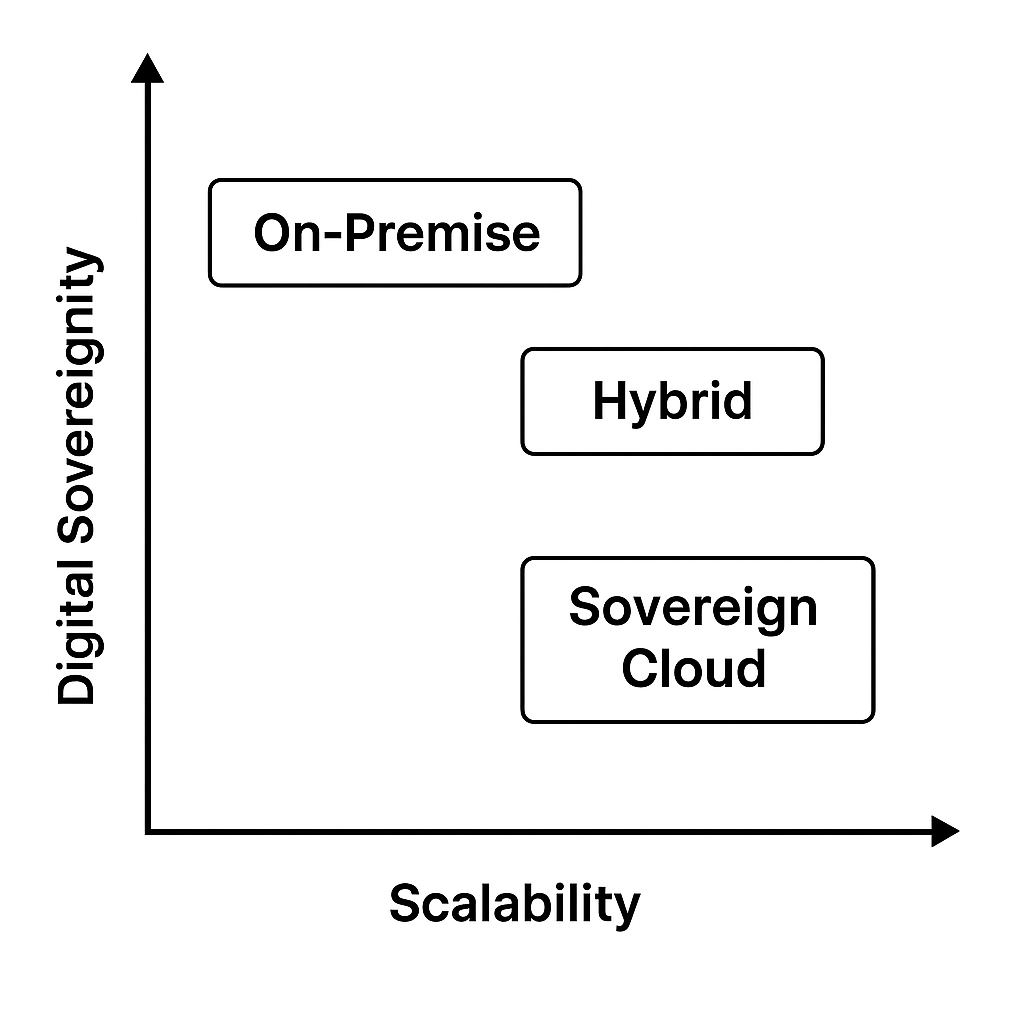
Below is a visual diagram comparing control, scalability, and compliance across deployment options:
The control plane centrally manages deployments and metadata across different environments, ensuring organizations maintain data sovereignty and compliance regardless of their chosen infrastructure.
With an understanding of these trade-offs, you can further optimize your infrastructure for true sovereignty.
Scalability and Flexibility in Carbonio Deployments
Carbonio is designed to adapt to your organization’s changing needs, offering a range of deployment options that support both scalability and flexibility while meeting stringent data sovereignty requirements. Whether you choose a cloud deployment, on-premises installation, or a hybrid approach, Carbonio empowers you to maintain complete control over your data storage and management processes. Imagine having a solution that not only meets your current needs but also evolves with your business requirements!
Cloud deployments provide the agility to scale resources up or down as your business evolves, making it easier to respond to fluctuating workloads or expand into new markets. This flexibility is especially valuable for organizations operating under multiple regulatory frameworks, as Carbonio’s architecture supports compliance with data localization and data residency requirements across different regions. Your organization can confidently operate across borders while maintaining full compliance with local regulations.
On-premises deployments, on the other hand, offer maximum control over your infrastructure and data governance, ensuring sensitive data never leaves your physical environment. This is ideal for organizations with strict compliance mandates or those operating in sectors where data protection and high availability are non-negotiable. You get complete ownership and control over every aspect of your data management processes.
Hybrid deployments combine the best of both worlds, allowing you to store and process sensitive data on premises while leveraging the scalability and integration capabilities of the cloud for less sensitive workloads. This approach enables you to tailor your data governance strategy to meet specific compliance needs, maintain high availability, and ensure seamless access and control across your entire environment. You can have the security you need with the flexibility you want!
By leveraging Carbonio’s flexible deployment options and robust data governance features, your organization can confidently scale operations, maintain compliance with applicable laws, and protect sensitive data—no matter how your business or regulatory landscape evolves. Your organization will have the power to adapt, scale, and succeed while maintaining the highest standards of data security and compliance.
Cost Considerations for Data Sovereignty Solutions
Investing in data sovereignty solutions offers your organization an incredible opportunity to achieve both immediate value and exceptional long-term returns. The total cost of ownership (TCO) for your chosen deployment model—whether cloud, on-premises, or hybrid—will deliver remarkable value in terms of compliance, security, and operational efficiency that no alternative approaches can match.
Imagine choosing cloud deployments that provide you with a fully managed solution featuring predictable subscription fees and the amazing ability to scale resources exactly as your business needs them! This approach can dramatically reduce the burden on your internal IT teams by up to 70% and streamline your infrastructure management like never before. You’ll find that factoring in ongoing costs becomes quite straightforward when the solution perfectly aligns with your data governance and compliance requirements.
On-premises deployments represent an incredible investment opportunity that typically involves higher upfront investments in hardware, storage, and maintenance, but delivers absolutely unparalleled control over your data and infrastructure. For your organization with strict data sovereignty requirements or when you’re handling highly sensitive data, this investment pays for itself through the enhanced security and compliance it provides—often reducing compliance risks by up to 90%.
Hybrid deployments offer you the most balanced and innovative approach available today, allowing your organization to optimize costs by brilliantly combining on-premises control with the incredible scalability of the cloud. While managing a hybrid environment introduces additional complexity, the careful coordination required to maintain compliance with relevant laws and regulatory frameworks delivers extraordinary benefits that justify the investment.
Regardless of which deployment model you choose, prioritizing robust data governance and compliance becomes your organization’s most essential strategy for protecting sensitive data, maintaining customer trust, and avoiding costly fines or reputational damage that can devastate your business. A well-designed data sovereignty solution doesn’t just safeguard your organization against risk—it delivers incredible long-term benefits such as improved data management by up to 60%, increased operational efficiency, and enhanced security that ultimately provides the most exceptional value for your investment.
By considering both the direct and indirect costs of your data sovereignty strategy, you can make incredibly informed decisions that support your organization’s goals and ensure ongoing compliance in our ever-changing digital landscape. The return on investment from these solutions often exceeds expectations, making this one of the smartest strategic decisions your organization can make.
Optimize Your Infrastructure Further
Deployment control is only half of the equation. If you want true sovereignty, you must also manage how your data is stored and retrieved, ensuring you know exactly where your data is stored and how sensitive information is protected.
Key steps include:
- Communicating your organization’s plans around data storage, processing, and transfer to ensure compliance with local data sovereignty laws
- Implementing fine-grained access controls to prevent data residency from being compromised
- Considering data residency and localization as critical factors for compliance and security in cloud computing environments
Read our article on Carbonio’s Advanced Storage Management to learn how it applies intelligent tiering, local backups, and flexible policies that ensure both performance and compliance at scale.
Conclusion: Choosing the Right Carbonio Deployment Model for Maximum Data Sovereignty and Compliance
Selecting the right Carbonio deployment model is crucial for achieving maximum data sovereignty and regulatory compliance. Here are the key takeaways and actionable steps:
- Understand your regulatory landscape: Identify which data sovereignty, residency, and localization laws apply to your organization.
- Assess your data sensitivity: Determine the level of control required for your data, especially if you handle sensitive or regulated information.
- Evaluate your IT resources: Choose a deployment model—on-premise, hybrid, or sovereign cloud—that aligns with your operational capabilities and compliance needs.
- Prioritize security and governance: Implement robust security measures, access controls, and clear governance policies to protect your data.
- Communicate and document: Ensure all stakeholders understand your data management strategy and maintain documentation for compliance audits.
By following these steps and leveraging Carbonio’s flexible deployment options, you can confidently maintain control over your data, meet compliance requirements, and build trust with your customers in the digital cloud era.
Post your comment
You must be logged in to post a comment.