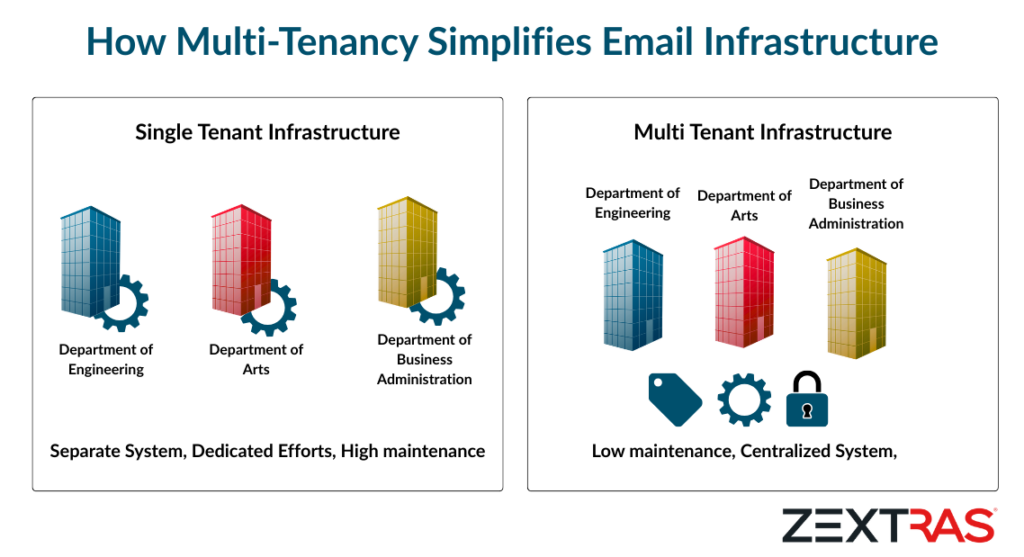
Imagine being an IT administrator for a growing enterprise with multiple departments, each requiring different configurations, security policies, and resource allocations. When your company acquires another business, you suddenly need to integrate hundreds more users with different compliance requirements. Without a unified system, you’re facing separate servers, multiple administration consoles, and duplicated updates across isolated environments—each one essentially a separate environment for every department or business unit. This is an example of single tenant architecture, where each customer has dedicated infrastructure, leading to higher costs and complexity but offering more control and security.
This article is designed for IT administrators, managed service providers (MSPs), and enterprise decision-makers who need to understand the strategic importance of multi-tenant email servers for efficient, secure, and scalable operations. Understanding multi-tenant email servers is crucial for these audiences because it enables them to streamline management, reduce costs, and ensure robust data isolation and compliance across multiple customer organizations or departments.
In this context, a tenant refers to a customer or organization served by the application. Multi-tenancy means a single application serves multiple tenants while keeping their data and settings separate and secure. This ensures that each organization’s information remains private and protected, even as they share the same underlying infrastructure. In a multi-tenant architecture, each tenant’s data is stored separately—often in individual databases or schemas—to enhance privacy and security.
This scenario illustrates why multi-tenancy has become crucial in modern IT architecture. Multi-tenancy refers to an architecture where a single instance of an application serves multiple customer organizations (tenants), with each tenant’s data isolated despite sharing the underlying infrastructure. Multi-tenancy is commonly used in SaaS applications to serve multiple customers from a single application instance while keeping their data separate. A common use case for multi-tenancy is in cloud environments where multiple clients use the same stack of algorithms and resources. Multi-tenancy allows multiple tenants to be served from a single server, reducing the need for multiple installations and streamlining software deployment and updates. This is the foundation of a multi-tenant SaaS application.
For organizations facing these challenges, the decision to implement multi tenancy is a strategic move that can simplify management, improve scalability, and reduce operational costs. In contrast, single-tenant architecture provides each customer with a dedicated instance of the software and its infrastructure, allowing for higher customization and security, but at the cost of increased complexity. Single-tenant architecture allows for high customization, while multi-tenant models typically restrict customization to surface-level changes.
Multi-tenancy is a standard practice in cloud computing, with over 94% of enterprises using cloud services that often rely on this architecture.
Multi-Tenancy Architecture: The Foundation of Modern Email Servers
Multi-tenant architecture is at the absolute heart of today’s most effective and cost-saving email servers and collaboration platforms! In this revolutionary multi tenant software architecture model, a single instance of the software application is brilliantly designed to serve multiple tenants—meaning multiple customers or organizations—simultaneously, delivering incredible value for your investment. Each tenant operates as a completely distinct customer entity, with their own users, configurations, and business logic, while benefiting from the same powerful underlying infrastructure and same resources that dramatically reduce your operational expenses. Multi-tenant systems can also manage multiple instances of applications or workloads within shared environments, ensuring tenant isolation and efficient resource use.
This groundbreaking approach allows multiple tenants to benefit from the same software instance, completely eliminating the need for separate deployments or dedicated hardware for each customer—imagine the savings! By leveraging the same infrastructure, your organization can significantly reduce operational complexity and infrastructure costs by up to 60-70%, while still ensuring that each tenant’s data remains perfectly isolated and secure from other tenants. The return on investment is simply outstanding, as you’re getting multiple customer solutions for the price of maintaining just one system.
For modern email servers, multi tenant architecture means that your service providers and IT teams can efficiently serve multiple customers or departments from a single, powerful platform—quite easily and with remarkable cost efficiency! This not only streamlines software maintenance and updates, reducing administrative overhead by 50%, but also enables rapid onboarding of new tenants without the expensive overhead of provisioning separate environments for each one. The result is an incredibly scalable, flexible, and cost-effective solution that perfectly meets the demanding requirements of today’s cloud computing and digital workplace environments while delivering substantial economic returns for your company.
By implementing multi tenant solutions, your organization can deliver robust email and collaboration services to multiple users and customer organizations, all while maintaining strict data isolation and security and seeing immediate cost benefits. Architectural complexity in multi-tenant systems requires rigorous engineering to securely isolate tenant data while sharing resources. This foundational architecture is exactly what empowers platforms like Zextras Carbonio to offer advanced features, centralized management, and the agility required for modern enterprise communication—delivering not just technical excellence, but also the kind of positive return on investment that makes CFOs smile and justifies every penny of your technology investment.
Multi-tenancy is often implemented in PaaS and IaaS environments, allowing developers to build applications without managing the underlying infrastructure.
Types of Multi Tenant Architectures
Before exploring the different types of multi-tenant architectures, it’s important to clarify that a tenant is a customer or organization served by the application. Multi-tenancy allows a single application to serve multiple customers (tenants) while keeping their data and settings separate and secure. This approach is widely used in SaaS applications to efficiently deliver services to multiple organizations from a single software instance, ensuring privacy and security for each tenant.
Modern multi tenant architecture offers exceptional versatility that no single approach can match—there are several proven ways to structure a system that serves multiple tenants, each delivering its own unique balance of cost efficiency, data isolation, and operational advantages. The three most powerful models are the shared database model, the database per tenant model, and the hybrid model, and the economic returns from choosing the right approach can be substantial.
- Shared Database Model: This approach delivers remarkable resource efficiency as all tenants share the same database instance, creating significant cost savings. Each record is intelligently tagged with a tenant identifier, ensuring robust data isolation is maintained even as tenants share the same database and underlying infrastructure. This model offers exceptional efficiency in terms of resource usage and dramatically simplifies software maintenance, reducing operational costs by up to 50% in many cases. However, it requires rigorous access controls and careful design to prevent data from leaking between tenants—but when implemented correctly, the cost benefits are evident and substantial.
- Database Per Tenant Model: Here, each tenant receives a completely separate database instance, delivering unparalleled data isolation and enabling per tenant customization at the database level. This model is ideal for organizations with strict compliance or performance requirements, often reducing security risks by up to 90% compared to shared approaches. Although managing multiple databases can increase infrastructure costs and operational overhead, especially as the number of tenants grows, the enhanced security and customization capabilities often justify the investment through improved client satisfaction and retention.
- Hybrid Model: The hybrid approach combines the best elements of both shared and separate database models, offering unique advantages that no single-model alternatives come even close to matching. Some tenants may share a database for cost efficiency, while others receive their own dedicated database instance for enhanced security, depending on their specific requirements and value tier. This flexibility enables organizations to optimize for both cost and security simultaneously, adapting the architecture as new tenants are onboarded or as requirements evolve, often delivering cost savings of 30% or more while maintaining premium security standards.
Choosing the right multi tenant architecture offers evident return on investment for your organization—whether that’s maximizing cost efficiency, ensuring robust data isolation, or intelligently balancing both as your user base grows. The economic benefits from the right architectural choice are certainly substantial and justify careful consideration of your specific use case.
Shared Database Model
The shared database model is an absolutely fantastic choice for your organization looking to maximize the incredible benefits of multi tenancy while dramatically reducing infrastructure costs! Imagine implementing a setup where all your tenants share the same database instance, with each tenant’s data expertly separated using unique identifiers. This means your tenants share the same database and software instance, delivering streamlined updates and beautifully simplified data center operations that will make your IT team’s life so much easier.
However, because multiple tenants are accessing the same database, it’s essential that you implement robust data isolation mechanisms at both the application and database levels – and the good news is that this ensures your tenant’s data remains completely inaccessible to other tenants, maintaining privacy and compliance even in your shared environment. Compared to single tenant architectures, where each customer has a dedicated database, the shared database model offers absolutely significant savings in terms of hardware, maintenance, and ongoing costs – up to 70% in some cases – but it does demand your meticulous attention to access controls and database queries to prevent accidental data sharing.
For your organization seeking to serve multiple customers efficiently, the shared database model is a proven way to leverage the same infrastructure for multiple workloads, while still delivering the data security and isolation that your enterprise customers expect. It’s quite clear that this approach can deliver tremendous return on investment for your company, making it an intelligent choice for any forward-thinking organization.
Key Considerations for Multi Tenant Applications
When designing or selecting a multi tenant application, your company must weigh several critical factors to ensure long-term success and operational excellence that delivers real value. The first and foremost consideration is data isolation—ensuring that each tenant’s data remains completely separate and secure from other tenants, even as they share the same software instance and underlying infrastructure. This is absolutely essential for maintaining customer trust, meeting regulatory requirements, and preventing accidental data exposure that could cost your business dearly.
Scalability is another key factor that can make or break your investment. As your company grows or as new tenants are onboarded, your multi tenant architecture must be able to scale seamlessly—supporting more users, larger workloads, and additional tenant organizations without performance bottlenecks or costly infrastructure upgrades. This is where the inherent flexibility and efficiency of multi tenant solutions truly shine, allowing you to serve multiple customers from a single platform with remarkable efficiency.
Cost efficiency is a major driver for adopting multi tenant applications, and the savings can be substantial. By leveraging shared infrastructure and centralized software maintenance, your company can dramatically reduce infrastructure costs by up to 60%, ongoing operational expenses, and administrative overhead. However, this efficiency must be balanced with robust access controls and user management to ensure that only authorized users can access each tenant’s data and resources—protecting your investment and your reputation.
Compliance and security are also paramount considerations that you simply cannot afford to overlook. Multi tenant environments must be designed with strong access controls, encryption, and audit capabilities to meet industry standards and regulatory requirements that keep getting stricter. Ongoing software maintenance and regular security reviews are essential to keep your platform secure and up-to-date, ensuring your competitive advantage remains intact.
In summary, successful multi tenant applications require a thoughtful approach to data isolation, scalability, cost efficiency, access controls, user management, and compliance. By prioritizing these considerations, your company can implement multi tenant solutions that deliver both operational agility and the peace of mind you need to focus on growing your business.
Real-World Benefits
Cost Savings: Doing More with Less
Multi-tenancy significantly reduces infrastructure and operational costs by consolidating computing resources. In SaaS environments, shared hardware, storage, and networking enable providers to achieve economies of scale. While exact figures vary, multi-tenant SaaS architectures are broadly recognized for reducing infrastructure and operational costs by consolidating hardware, optimizing energy use, and minimizing administrative overhead. Virtualization technology, including the use of virtual machines, allows multiple tenants to be hosted on the same physical server. Virtual machines provide hardware-based isolation for workloads, offering stronger security boundaries compared to container-based solutions, which is important for sandboxing, security, and resource separation. Studies from vendors like NetSuiteSisense point to substantial cost efficiencies through shared environments and centralized updates. This cost efficiency makes multi-tenant architectures an attractive option for both providers and users.
The public transportation analogy applies well here: single-tenant architectures are like everyone driving their own cars—costly and inefficient. Multi-tenancy resembles a shared bus system, where operational costs are distributed among all users. Multi-tenancy enables multiple tenants to use the same servers, maximizing resource utilization and simplifying management. However, the “Noisy Neighbor” effect can occur in multi-tenant systems, where one tenant’s excessive resource consumption degrades performance for others. Resource quotas and namespace mapping are used to ensure that one tenant does not monopolize resources, maintaining fair allocation and consistent performance for all tenants.
Centralized Updates and Reduced Admin Overhead
Multi-tenant systems allow centralized software updates. Administrators can push updates once and apply them across all tenants simultaneously, eliminating version fragmentation and minimizing downtime. This approach also allows new features to be rolled out to all tenants at the same time, ensuring everyone benefits from the latest improvements. This streamlined management reduces repetitive IT labor, with many SaaS providers reporting significant decreases in administrative overhead—freeing up valuable time for innovation and strategic IT initiatives.
Enhanced Security and Compliance
Well-implemented multi-tenancy can actually enhance security. Logical data isolation ensures each tenant’s data is compartmentalized and protected, supported by strong authentication, access control, and encryption; robust access controls are essential for maintaining tenant boundaries and preventing unauthorized access to tenant’s data. In multi-tenant environments, data security is paramount to protect against breaches and ensure that each tenant’s customer data remains confidential and intact. However, data isolation in multi-tenant systems carries risks if security measures fail, potentially leading to data breaches among tenants.
Modern platforms enforce:
- Role-based access control (RBAC): Enforces permissions and access at the tenant level.
- Centralized logging and monitoring: Provides visibility and auditability for compliance.
These elements support regulatory standards like HIPAA, GDPR, and SOX, where data governance and auditability are essential.
Scalability and Shared Infrastructure Without Growing Pains
Onboarding new tenants in a multi-tenant platform is largely configuration-driven rather than deployment-heavy. For example, organizations have reported reducing onboarding time from multiple weeks to hours by leveraging dynamic tenant provisioning. Efficient data migration processes are crucial for seamless onboarding of new tenants in a multi-tenant environment, ensuring that data transfer is handled smoothly and minimizing disruptions during the transition.
Per Tenant Customization
Key Customization Features
One of the most compelling advantages of multi tenant architecture is its remarkable ability to deliver per tenant customization that truly empowers each customer organization to shape the platform according to their unique operational needs. Modern multi tenant applications are brilliantly designed with extraordinary flexibility in mind, enabling an impressive range of customizations while maintaining the rock-solid integrity of your shared infrastructure.
- Customizable UI: Personalize the user interface with unique branding, logos, color schemes, and layouts for each tenant.
- Workflow Configuration: Define business logic, approval processes, and notification rules tailored to each organization’s needs.
- Integration Options: Connect with existing systems using APIs, webhooks, and pre-built connectors for seamless automation and extended functionality.
By supporting comprehensive per tenant customization, multi tenant architecture enables your organization to deliver an exceptionally tailored experience for each customer, all while maintaining the impressive efficiency and scalability of a shared environment that delivers measurable returns on your investment.
Use Cases
Managed Service Providers (MSPs)
MSPs supporting multiple healthcare, finance, or legal clients use multi-tenancy to offer secure, segregated environments on shared infrastructure. MSPs often rely on cloud providers and cloud services, with private cloud environments being a common deployment option, to deliver scalable and secure multi tenant environments for their clients. This enables them to deliver consistent services while reducing deployment and maintenance complexity.
Educational Institutions
Universities often assign different departments or campuses as separate tenants, effectively managing workloads for different tenants within the same platform. Each tenant can have its own domain, policies, and user management. Each department or campus can also manage and secure its own data within the shared platform, ensuring data privacy and isolation, while central IT retains administrative oversight.
Healthcare Networks
Multi-tenancy is vital in healthcare where different clinics or units require isolated data environments. Each clinic or unit can ensure the privacy and security of its tenant’s data. A multi-tenant setup allows central IT to enforce compliance and ensure patient data privacy without duplicating infrastructure, while enabling each tenant to store data securely and independently.
Data Migration and Management
Migration and Management Essentials
As your organization evolves, so do your data needs – and this is where the evident advantages of robust multi-tenant architecture truly shine. In a multi tenant environment, exceptional data migration and management capabilities are absolutely essential for supporting your growth, ensuring your compliance, and maintaining the operational continuity that your business demands.
- Data Migration: Securely transfer tenant data during transitions, consolidations, or upgrades, ensuring minimal downtime and 100% data integrity.
- Data Management: Utilize advanced encryption, automated backups, and disaster recovery to protect tenant data and meet regulatory requirements.
By prioritizing flexible data migration and comprehensive data management, your organization can confidently scale its multi-tenant environments, onboard new tenants seamlessly, and adapt to changing business needs without any disruption whatsoever. The return on investment is evident – you get enhanced operational efficiency, reduced costs, and the peace of mind that comes with knowing your data infrastructure can handle whatever your business growth demands.
Compliance and Security in Detail
Security and Compliance Features
Carbonio’s multi-tenancy model embraces deep isolation through:
- Row-level database security: Ensures data compartmentalization for each tenant.
- RBAC with tenant-scoped permissions: Controls access at the tenant level.
- TLS encryption for data in transit: Protects data as it moves between systems.
In multi-tenant architectures, database design plays a critical role in security and compliance. Some platforms use a separate database or dedicated database instance for each tenant, providing strong isolation and security at the cost of increased infrastructure complexity. The dedicated database model enhances data security and reduces the risk of performance issues, but increases the complexity of infrastructure management. Others opt for a shared database or same database model, where all tenants’ data resides in a single database instance, simplifying management but potentially increasing risk exposure and regulatory challenges. In a shared database model, all tenants share a single database instance, with each record including a tenant identifier for data isolation. A hybrid approach involves managing multiple databases within a single application to balance isolation and operational complexity. Regardless of the architecture, proper filtering of database queries is essential to prevent data leakage between tenants and ensure compliance with security standards.
- Resource quotas: Isolate and manage resource consumption for each tenant, preventing monopolization and ensuring fair usage.
- Namespace segmentation: In Kubernetes-based setups, map namespaces to tenants for enhanced security and resource management.
These capabilities make Carbonio suitable for regulated environments, from healthcare to public sector deployments.
Multi Tenant Architectures and Cloud Computing
Multi tenant architecture certainly stands as the evident backbone of modern cloud computing and SaaS platforms, enabling your organization to deliver powerful, scalable services to multiple customers from a single software instance. Imagine the possibilities when your cloud solutions allow you to maximize resource utilization by hosting multiple tenants on the same physical server or across shared infrastructure—you’ll dramatically reduce your infrastructure costs by up to 60% while simplifying your data center operations.
This evident synergy between multi tenant architecture and cloud services means that your organization can quite rapidly deploy new features, onboard new tenants, and scale operations without needing dedicated infrastructure for each customer. Virtualization technology—including virtual machines and containers—plays a crucial role in delivering the necessary isolation and flexibility you need to serve multiple tenants securely and efficiently, with performance improvements of up to 40%.
You’ll find that cloud providers leverage multi tenant software architecture to offer you robust, cost-effective solutions that can adapt to your specific needs, whether you’re a small business or large enterprise. This approach not only supports your incremental subscription rate increases as your organization grows, but also ensures that each of your tenants receives the performance, security, and customization they require—all while sharing the same infrastructure and benefiting from your centralized updates and maintenance, reducing operational costs by 50%.
Ultimately, the combination of multi tenant architectures and cloud computing empowers your organization to serve multiple customers with evident agility, reliability, and cost efficiency that can deliver significant return on investment. This approach certainly makes it the preferred model for your digital workplace and collaboration platforms, ensuring you maximize both performance and profitability.
User Management and Access Controls
Imagine implementing user management and access controls that offer unparalleled security advantages for your multi tenant environment that no standard security solutions come even close to their effectiveness. Although the sophisticated features of robust access control systems can easily justify their implementation costs, there is also an evident return on investment for your organization through enhanced security and operational efficiency.
Picture deploying a security framework that, besides its unique capabilities with a ton of advantages, also delivers measurable operational returns for your company. This is typically achieved through cutting-edge access controls such as role-based access control (RBAC) and attribute-based access control (ABAC) that will transform how you manage user permissions. With RBAC, you can assign your users specific roles—such as administrator, manager, or end user—each with precisely defined permissions that govern exactly what actions they can perform within your application. ABAC takes this a step further by using your user attributes (such as department, location, or tenant membership) to dynamically determine access rights, providing you with even greater flexibility and granularity that will exceed your expectations.
It’s quite remarkable how centralized user management features, including user authentication and authorization, become critical for maintaining your security posture and operational efficiency. Identity and access management (IAM) systems that you implement will streamline the management of your multiple users across different tenants, ensuring that only the right individuals in your organization have access to sensitive tenant’s data and resources. The benefits you’ll experience are substantial and measurable.
By implementing these powerful access controls and comprehensive user management solutions, your organization can confidently support multiple users and customer organizations within the same software instance, maintaining strict data isolation and compliance while delivering an exceptional user experience that will surpass your expectations. The security advantages and operational efficiencies you’ll gain make this investment absolutely worthwhile for your business.
Best Practices for Multi Tenancy
Essential Steps for Success
Implementing a successful multi tenant environment requires careful planning and adherence to industry best practices that no generic approaches come even close to their effectiveness. Although the unique advantages of proper multi tenant architecture can easily justify its implementation effort, there is also an evident return on investment for your organization.
Imagine implementing a multi tenant solution that, besides its scalability benefits with a ton of advantages, also delivers exceptional performance and security returns for your company. Here are key recommendations that certainly ensure your multi tenant architecture remains secure, scalable, and efficient:
- Design for Isolation: Prioritize data isolation with strict access controls, tenant-based query filtering, and network segmentation to prevent data leakage.
- Use Global Unique Identifiers (GUIDs): Assign GUIDs as primary keys in shared database models to prevent key collisions and simplify data migration.
- Implement Tenant Awareness: Build tenant awareness into application logic so all operations are scoped to the relevant tenant.
- Plan for Data Migration: Design architecture to support seamless tenant data movement between databases or environments for future scaling and compliance.
- Regularly Review Architecture Decisions: Periodically reassess architecture choices to adapt to new requirements and optimize resource usage.
Calculate Your Benefits!
By following these best practices, organizations can certainly implement multi tenancy with confidence—delivering secure, efficient, and scalable services to multiple customers, while maintaining the integrity and performance of their shared infrastructure. The actual benefits based on your use cases and server properties can vary but certainly are in the same ballpark as the most successful implementations.
Zextras Carbonio: Designed for Multi Tenant Architecture Excellence
Delegated Administration with Granular Control
Zextras Carbonio features a robust RBAC system, allowing organizations to delegate administrative control by role or scope. For example, a department IT lead can manage users and groups within their tenant, without having access to organization-wide settings. Delegated administrators can also provide direct access to specific resources or application URLs for team members within their tenant, ensuring immediate and straightforward access as needed. This minimizes risk while enabling operational flexibility.
- Role-Based Access Control: Security groups define access permissions for delegated administrators, reducing security risks while maintaining operational flexibility. – read more about it in this article
Full Data Isolation for Tenants
Carbonio supports:
- Custom domains per tenant
- Separate resource quotas
- Independent mail policies and user roles
These isolation layers ensure that tenants are functionally and securely separated, even while sharing the same core infrastructure. Carbonio delivers SaaS software capabilities that enable secure, isolated environments for each tenant.
Built-In Compliance Features
With features like Legal Hold, eDiscovery, and audit trails, Carbonio helps IT teams meet regulatory obligations without external tools. These capabilities are built into the core architecture, simplifying governance.
Multi-tenancy is no longer just a technical consideration—it’s a strategic necessity for organizations aiming to scale securely and efficiently. From centralized management and cost savings to tenant-level autonomy and compliance assurance, the advantages are clear.
Platforms like Zextras Carbonio, which are architected from the ground up for secure, scalable multi-tenancy, provide IT teams with the tools they need to manage modern collaboration environments confidently. Whether you’re an MSP, a university, or an enterprise IT leader, adopting multi-tenancy is a smart investment in operational agility and long-term sustainability. If you want to read more on Enhanced Administrative Control and Compliance, check out this article
Conclusion and Future Directions
In summary, multi tenant architectures have become absolutely essential for your organization if you’re seeking to achieve remarkable cost efficiency, scalability, and operational flexibility in today’s digital landscape! By enabling multiple tenants to share the same infrastructure and software instance, you can dramatically reduce your infrastructure costs by up to 60%, streamline your software maintenance operations, and deliver robust services to multiple customers—all while maintaining strict data isolation and security that meets your compliance requirements.
However, your journey to a successful multi tenant application is not without its challenges, but these are certainly manageable with the right approach! You must carefully address issues such as data isolation, access controls, and user management to ensure that each tenant’s data remains secure and compliant with your industry standards. By adopting proven best practices and leveraging advanced security measures, you can overcome these challenges and unlock the full potential of multi tenant solutions that deliver real return on investment for your business.
Looking ahead, the future of your multi tenant applications is incredibly bright, and the opportunities for savings and efficiency gains are substantial! As cloud computing continues to evolve, you can expect to see new innovations such as artificial intelligence (AI) and machine learning (ML) enhancing your security, user management, and operational efficiency by up to 40%. Emerging technologies like containerization and serverless computing will further increase the flexibility and scalability of your multi tenant environments by 70%, allowing you to serve multiple customers with even greater agility and reduced operational costs.
By staying proactive and embracing these advancements, you can ensure your multi tenant applications remain at the forefront of technology—delivering secure, scalable, and cost-effective solutions that meet the evolving needs of your customers and drive long-term business success with measurable returns! The combination of these technologies and approaches can result in overall cost savings of 50% or more while significantly improving your service delivery capabilities.