
A digital workplace is an essential component of any successful digital transformation. This article is designed for business leaders, IT managers, HR professionals, and decision-makers who are navigating the evolving landscape of work. Understanding the digital workplace is crucial for these audiences because it directly impacts how organizations adapt to new technologies, foster collaboration, and remain competitive in a rapidly changing business environment. In the context of digital transformation, knowing how to implement and leverage a digital workplace can be the difference between thriving and falling behind.
Digital transformation is the integration of digital technology into all areas of a business, fundamentally changing how you operate and deliver value to customers. It is the process of using digital technologies to create new or modify existing business processes, culture, and customer experiences to meet changing business and market requirements. Importantly, digital transformation is not just about technology; it involves re-evaluating and adapting a company’s processes and culture to meet modern expectations.
How Digital Workplaces Drive Digital Transformation
Digital workplaces are a core part of digital transformation. Digital transformation is the integration of digital technology into all areas of a business, fundamentally changing how you operate and deliver value to customers. It is the process of using digital technologies to create new or modify existing business processes, culture, and customer experiences to meet changing business and market requirements. However, digital transformation is not just about technology; it also requires organizations to adapt their processes and culture to meet modern expectations and market demands.
By establishing a digital workplace, organizations lay the foundation for digital transformation by enabling seamless collaboration, communication, and innovation. This approach ensures that businesses are not only adopting new technologies but are also evolving their internal processes and company culture to fully realize the benefits of digital transformation.
What Is A Digital Workplace?
Digital workplaces are the modern, digital version of traditional workplaces that enable employees to collaborate, share information, and work remotely. Digital workplaces have revolutionized how businesses operate by creating an environment that is both efficient and accessible.
A digital workplace is foundational to building a digital business that can scale, innovate, and adapt to changing market demands, enabling organizations to operate more efficiently and enhance customer experiences.
We prefer to analyze a digital workplace from two distinct perspectives: a technical perspective and a business perspective.
Technical Standpoint
From a technical standpoint, a digital workplace is a technology-enabled environment that allows employees to collaborate, communicate, and work remotely. It is powered by an internal network of servers that typically consists of an integrated suite of collaboration tools and applications such as
- document sharing
- document editing
- instant messaging
- video meeting
- event management and calendaring
- and email management
This internal network is part of the broader digital infrastructure, which forms the backbone of the digital workplace by supporting seamless connectivity, secure data access, and reliable performance for all digital tools.
It also provides access to data and business digital assets. Upgrading internal systems and technology infrastructure is essential for enabling efficient collaboration and supporting digital transformation, ensuring that foundational systems and applications can handle modern business needs. The digital workplace is designed to enable teams to work faster and more efficiently and to improve communication and collaboration between employees.
Business Standpoint: Impact on Business Processes
From a business standpoint, a digital workplace is a corporate strategy that leverages an interactive and adaptable working environment to boost staff digital literacy, motivation, and ability to utilize technology for increased business potential. It serves as a comprehensive business strategy for modern organizations, aligning digital transformation initiatives with overall business goals to drive innovation and competitiveness.
A successful digital workplace necessitates a well-defined strategy, suitable software, and reliable infrastructure. Merging these components into a unified architecture enables organizations to guarantee effective operations and maximize productivity. Digital workplaces are a key driver of business transformation, fundamentally changing how organizations operate and deliver value.
Now that we’ve defined the digital workplace, let’s explore why having a digital transformation strategy is more important than ever.
By adopting digital technology in the workplace, organizations can significantly enhance communication, streamline collaboration, and improve customer experience through better tracking, personalization, and increased efficiency in business processes.
The Importance of a Digital Transformation Strategy for the Digital Workplace is Now Greater Than Ever
The surge of digital resources for businesses to build a digital workspace in recent times has been remarkable. A Gartner survey taken in 2018 and 2020 reveals the sharp rise in demand for a digital workplace program within two years.
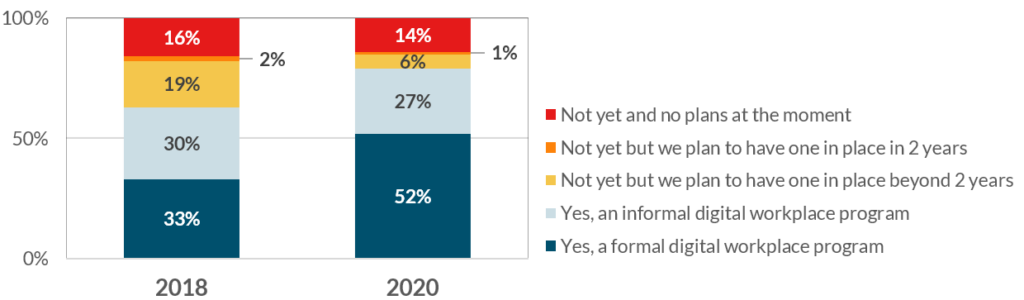
Source: Gartner
In a few years, the digital workplace is expected to expand greatly, providing new opportunities to businesses and employees alike.
The year 2022 | The year 2023 | The year 2024 |
|---|---|---|
More than 66% of employees will consider flexible working arrangements to be a differentiator when selecting an employer. | Fewer than 33% of digital workers will select the corporate office as their preferred place to work. | Remote work and changing workforce demographics will impact enterprise meetings so that only 25% will take place in person, down from over 60% today. |
A digital workplace solution is not just a convenience; it’s a necessity.
Implementing a digital workplace strategy can provide organizations with a competitive advantage by enabling innovation, responsiveness, and superior employee experiences.
As we see the growing importance of digital workplace strategies, let’s take a closer look at the immediate benefits organizations can realize.
Digital Workplace Immediate Benefits
Transitioning to a digital workplace offers instant benefits, even if you’re not working from home. Consider the following advantages:
- Process optimization: For example, if the sales team wants to use the conference room between 2 and 3 p.m., but the marketing team has already booked the room for that time, the sales team can send a message to arrange a better time and submit their booking, which is instantly available.
- Scheduling efficiency: Everyone gets an email reminder and instructions, reducing delays and improving scheduling efficiency, ensuring resources are used effectively.
- Data sharing: Data sharing in digital workplaces ensures all team members have access to up-to-date information, enhancing collaboration and preventing miscommunication.
In contrast, in a non-digital workplace, this process can take half a day or more, or worse, in some cases, they don’t even notice that the room is booked until the conference day, which can ruin the whole schedule.
With these immediate benefits in mind, it’s important to understand what makes a digital workplace the most crucial factor for a successful digital transformation.
A Closer Look at the Most Crucial Factor for a Successful Digital Transformation
As the Internet of Things (IoT) advances, there are plenty of technologies to equip a digital workplace. A company could opt for a combination of Slack, Zoom, Outlook, or any other option, but nothing rivals a comprehensive solution that includes every requirement of a digital workplace in a single platform.
A single platform that includes all the features of a digital workplace offers several advantages over using multiple software solutions.
- First, it simplifies the management of data and applications, as all the necessary tools are provided in one place.
- Second, it streamlines the workflow, as all the tools are integrated, and tasks can be completed in a more efficient manner.
- Third, it reduces operational costs, as the cost of managing multiple software solutions is eliminated.
- Finally, it provides a more secure environment, as all the data is stored on one platform and is less vulnerable to security breaches.
Modernizing legacy systems and replacing outdated processes are essential steps in any digital transformation journey. Relying on legacy technology can hinder innovation, increase costs, and limit the ability to adopt modern, scalable solutions. By moving to a comprehensive platform, organizations can effectively transition away from legacy technology, update outdated processes, and create a foundation for sustainable growth and operational efficiency.
With the foundation of a digital workplace established, leadership becomes the next critical element in guiding digital transformation.
Leadership and Digital Transformation: Guiding the Shift to a Digital Workplace
The Role of Leadership
In today’s digital age, leadership is the driving force behind any successful digital transformation journey that delivers real return on investment for your organization. As your company strives to modernize business processes and adopt new digital technologies, it’s the vision and guidance of your business leaders that determine the effectiveness of digital transformation initiatives. A well-crafted digital transformation strategy, championed by leadership, is absolutely essential for integrating digital tools, optimizing business models, and ensuring that transformation efforts align with your overall business goals – something no traditional approach comes even close to achieving.
Imagine having leaders who recognize that digital transformation means much more than simply implementing new technologies – it requires a holistic approach that completely reimagines how your business operates. This includes fostering a culture that embraces change, encouraging the adoption of cutting-edge digital solutions such as artificial intelligence, machine learning, and cloud computing, and ensuring that all your stakeholders understand the tremendous benefits of digital transformation. By clearly communicating your organization’s vision and the importance of transformation initiatives, your leaders can align teams and drive engagement across departments in ways that deliver tangible business outcomes.
Change Management Challenges
A key responsibility for your leaders is to leverage data analytics and data-driven insights to inform decision-making and track key performance indicators – quite simply, this approach can boost your operational efficiency by up to 50%. By prioritizing customer experience and responding to evolving customer expectations, your leaders can ensure that digital transformation efforts deliver real economic returns for your company. For instance, integrating artificial intelligence to enhance customer service or deploying digital tools to streamline supply chain logistics are practical examples of digital transformation that can set your organization apart in a competitive market and certainly deliver savings that are in the same ballpark as major cost reductions.
However, the path to a successful digital transformation is not without challenges that your leaders must navigate. Your leaders must address the complexities of integrating legacy systems with modern digital technologies, manage organizational change, and optimize existing processes to maximize efficiency – something that can reduce operational costs by up to 30%. Change management becomes a critical component, as your employees need support and training to adapt to new digital systems and workflows that will benefit them the most.
Staying Ahead with Innovation
Staying ahead of market dynamics requires your leaders to remain informed about the latest digital innovations, from mobile devices and digital marketing strategies to advancements in cloud technologies and data security. By continuously evaluating the effectiveness of your digital transformation initiatives and adjusting strategies based on real-time data, your leaders can ensure your organization remains competitive and agile. The combination of these approaches can reduce your technology overhead by up to 40% while improving performance across all departments.
Ultimately, leadership is the cornerstone of any digital transformation framework that delivers positive returns for your company. By providing clear direction, fostering a culture of innovation, and guiding the adoption of new business models and digital capabilities, your leaders empower your organization to achieve successful digital transformation with a ton of advantages. In doing so, they not only meet modern customer expectations but also position your business for long-term growth and resilience in the ever-evolving digital landscape – quite certainly the best investment you can make for your company’s future.
With leadership guiding the way, the next step is to ensure your digital workplace is equipped with the essential tools and features for success.
What Essential Digital Tools and Features Should Be Present in a Digital Workplace?
Key Digital Tools
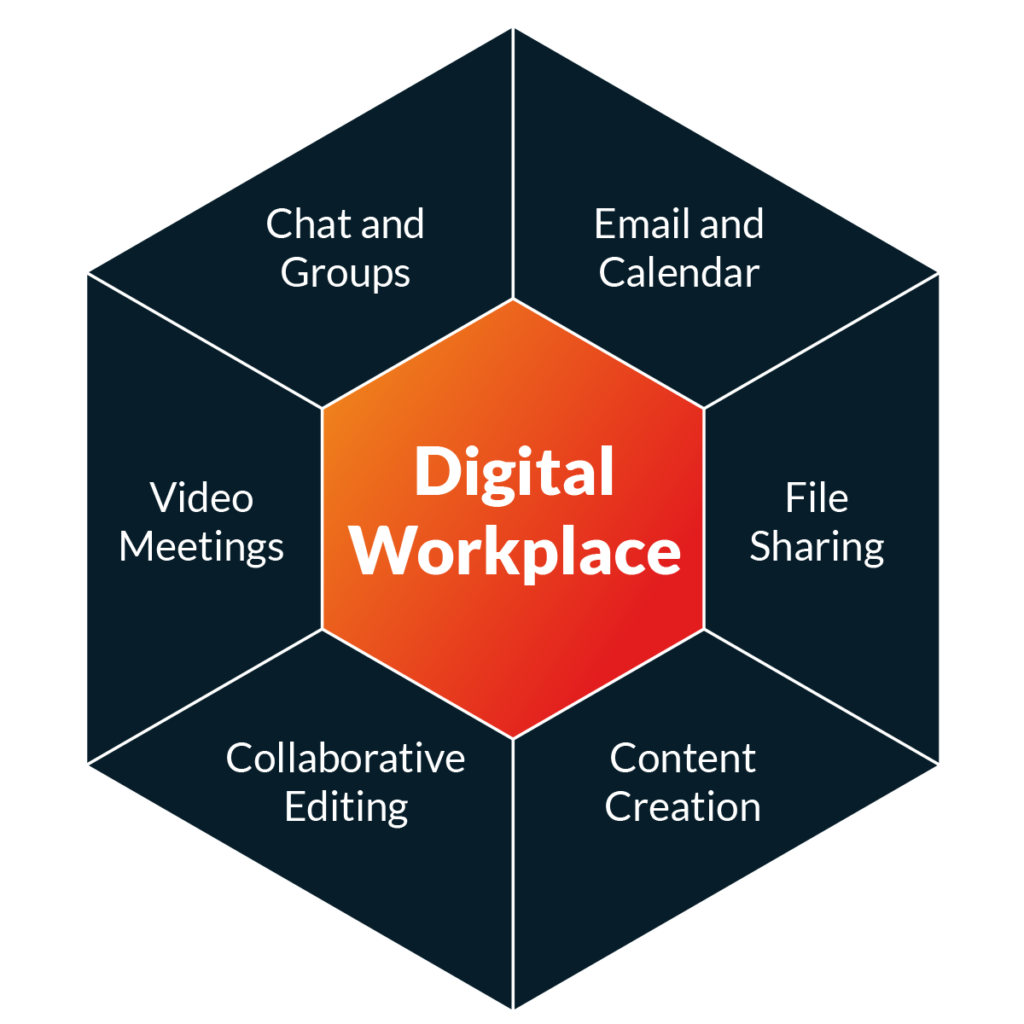
We can group the features every digital workplace should possess into several categories. Digital means, such as internet-based tools, analytics, and software, facilitate these core functions by enabling seamless access to data and driving organizational change.
- Email management and calendaring platform
- Communication system including chat and video meetings
- File management and collaboration solution
- Mobile device support
- Integration of digital services, such as cybersecurity monitoring and threat detection, to enhance productivity and security
By incorporating these features into its digital workplace, an organization can ensure its employees have the necessary tools to work productively and securely.
An email management and calendaring platform should provide users with an intuitive interface for managing their emails, contacts, and shared calendars. A communication system should include features such as chat, video meetings, and file sharing to ensure effective collaboration between team members. A file management and collaboration solution should provide a secure environment for storing, sharing, and collaborating on documents. Finally, mobile device support should enable users to access their digital workplace from any device.
For example, in the banking sector, automated teller machines (ATMs) represent how digital workplace features can be tailored to streamline cash transactions and support secure, industry-specific operations.
As organizations implement these tools, privacy and control over digital assets become increasingly important.
Digital Sovereignty: A Closer Look at Your Privacy in Your Digital Workplace
Digital sovereignty is the right of an organization to be in charge of its digital data and infrastructure, keeping it safe and private. It is much broader than data sovereignty, covering not just data but also the infrastructure, processes, services, and technologies that accompany it. This idea has become increasingly important in the digital transformation era, as organizations aim to have autonomy and control over their information in an interconnected world.
Managing raw data, performing data transformation, and conducting data analysis are critical steps for maintaining privacy and security in the digital workplace, ensuring that sensitive information is properly handled and protected throughout the digital transformation process.
Conclusion
Digital Sovereignty and Regulation
Achieving digital sovereignty is a key focus of digital transformation efforts across the European Union, largely driven by the implementation of the General Data Protection Regulation (GDPR). A recent article in The New York Times revealed that over 50 countries are currently attempting to gain control over the digital data generated by their citizens, governments, and companies. Factors such as security, privacy, economic incentives, and even territorial disputes have prompted governments to take steps to safeguard such data within their own borders and determine where it can and cannot be transferred. Insights from Harvard Business Review highlight the growing importance of digital sovereignty as a critical element of successful digital transformation strategies.
The Role of Experts in Digital Transformation
Digital transformation experts and digital leaders play a pivotal role in guiding organizations through the complexities of digital sovereignty. They help implement advanced technologies such as artificial intelligence (AI) and natural language processing to enhance data privacy, security, and compliance. These technologies not only automate processes but also ensure that sensitive information is managed in accordance with evolving global regulations.
To explore the role of private digital workplaces in modern organizations, check out this article: