
Introduction
Cloud repatriation is the process of moving workloads from public cloud environments back to on-premises data centers or private clouds. As organizations increasingly evaluate their cloud strategies, the debate between public and private cloud solutions has intensified. This article covers what cloud repatriation is, why organizations are moving workloads back from public to private cloud, the benefits and challenges, and how to approach the process.
This guide is intended for IT leaders, decision-makers, and business professionals evaluating cloud strategies. Understanding cloud repatriation is crucial as organizations seek to optimize costs, improve security, and maintain compliance in an evolving IT landscape.
Cloud repatriation and hybrid cloud solutions are increasingly recognized as key enablers of digital transformation, helping organizations modernize IT environments and drive business innovation.
Cloud repatriation has become a significant trend as businesses reassess their cloud investments and look for ways to better align IT infrastructure with business objectives. In the following sections, we’ll define cloud repatriation, explore why it’s happening, discuss the benefits and challenges, and provide guidance on how to approach the process.
The Great Cloud Debate: Public Cloud vs. Private Cloud
The debate between public cloud and private cloud solutions has intensified recently. While the public cloud has gained traction for its scalability and ease of use, a growing number of businesses are rethinking their strategies. Cloud repatriation—the process of moving workloads from public cloud environments back to on-premises data centers or private clouds—signals a significant shift in how organizations approach their IT infrastructure. Initial cloud adoption was often driven by the promise of scalability and flexibility, but organizations are now reassessing their choices to ensure alignment with their overall business objectives.
To help clarify the differences, here’s a simple comparison table:
Attribute | Public Cloud | Private Cloud / On-Premises |
|---|---|---|
Scalability | High, on-demand | Customizable, but may require planning |
Cost Structure | Pay-as-you-go, variable | Upfront investment, predictable costs |
Security | Shared responsibility, less control | Full control, customizable policies |
Compliance | May be challenging for some sectors | Easier to enforce strict compliance |
Vendor Lock-In | Higher risk | Lower risk, more flexibility |
Performance | May vary, depends on provider | Tuned for specific workloads |
This shift in thinking has led to the rise of cloud repatriation, which we will explore in the next section.
Cloud Infrastructure and Solutions
Cloud infrastructure and solutions are at the heart of any successful cloud repatriation strategy you implement, providing the foundation for your organization to move workloads from public cloud environments back to your on-premises data centers or private clouds. As your business seeks to regain greater control over its IT landscape, private cloud infrastructure stands out for its enhanced security, cost optimization, and ability to meet your strict regulatory requirements—especially if you’re handling sensitive data or operating in heavily regulated industries.
When you’re evaluating cloud solutions, it’s essential that you look beyond the surface-level benefits of public cloud services and consider your total cost of ownership. Public cloud environments often introduce hidden expenses such as data transfer fees, egress fees, and escalating storage costs, which can quickly erode your perceived cost efficiency. By contrast, private cloud infrastructure enables your organization to achieve predictable costs, optimize your resource allocation, and realize significant cost savings over time—in some cases, savings can be up to 60% compared to your previous public cloud expenses!
Hybrid cloud solutions are increasingly popular among organizations like yours, allowing you to blend the flexibility of public cloud with the security and performance of your on-premises infrastructure. This approach supports optimal workload placement for your needs—keeping your latency-sensitive applications, real-time analytics, and mission-critical workloads close to home, while leveraging public cloud for your less sensitive or highly elastic tasks. Your edge computing and cloud native applications further benefit from this model, as they require the low-latency, high-performance environments that you can fine-tune for your specialized workloads.
A smooth repatriation process depends on your careful planning and the right migration tools for your organization. You should develop a comprehensive migration plan that addresses your data security, network configurations, and custom security policies to protect your sensitive data throughout the transition. Continuous monitoring and strict controls are vital for you to minimize the risk of data loss and ensure compliance with your regulatory requirements. Service quality and support from your cloud providers also play a crucial role, particularly if you’re in sectors where downtime or data breaches are simply unacceptable for your business.
Ultimately, cloud repatriation is about you achieving greater control, cost predictability, and workload elasticity while enhancing your security and optimizing your performance. By thoughtfully assessing your cloud infrastructure and solutions, you can tailor your approach—whether you’re moving your data and applications back to on-premises infrastructure, adopting a hybrid cloud model, or leveraging advanced analytics and edge computing for your operations. This strategic flexibility empowers your business to align your IT environment with your unique objectives, ensuring that your cloud remains a true enabler of innovation, compliance, and operational excellence.
The Rise of Cloud Repatriation: What It Is and Why It Matters
Cloud repatriation refers to the process of moving workloads from public cloud environments back to on-premises data centers or private clouds. Recent surveys show that this trend is rapidly growing, with 83% of CIOs planning to repatriate workloads in 2024, a significant jump from 70% in 2023:
Open image-20240911-125207.png
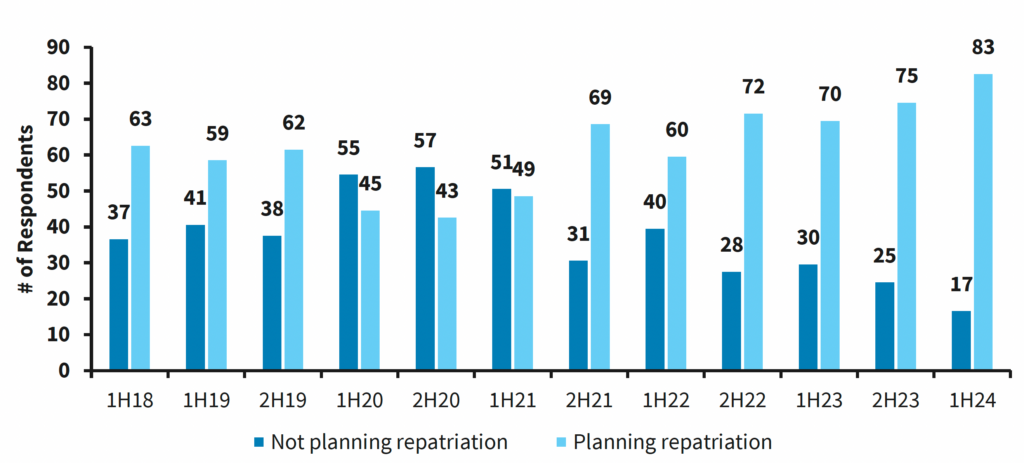
Source: Barclays CIO Survey – Percentage of Respondents Planning to Move Workloads Back onto Private Cloud / On-Premise from Public Cloud – Figure 20
This process is often called workload repatriation, which involves moving infrastructure or cloud workloads back from public cloud providers to private or on-premises environments. Importantly, workload repatriation does not mean reverting to outdated systems; instead, it leverages modern private cloud solutions to give organizations better control, reduce costs, and reallocate resources more efficiently.
Organizations are realizing that while the public cloud offers scalability, it’s not always the most cost-effective or secure option for every workload—certain workloads are better suited for private infrastructure. Storage, computing, and databases are leading the charge in this shift, with organizations moving these resources between public and private clouds as part of their hybrid strategies.
As we move forward, let’s examine why cloud repatriation is becoming increasingly important for organizations.
Why Cloud Repatriation Is Important
1. Cost Efficiency
While public cloud solutions initially seem cheaper, many businesses are discovering that costs can spiral as workloads grow, with escalating costs and rising cloud costs becoming key concerns. The pay-as-you-go model of the public cloud may be great for small workloads, but for businesses with constant, high-demand operations, the costs can balloon.
Cloud repatriation can lead to cost optimization and more predictable costs by reducing operational expenses associated with public cloud environments. By moving workloads on-premises or to private infrastructure, organizations can better control spending and avoid unpredictable cloud expenditures.
When considering repatriation, organizations also evaluate the total cost of ownership to determine if the move will result in overall cost savings after factoring in infrastructure, staffing, and maintenance.
2. Security and Compliance
Security is a growing concern in the public cloud. Organizations in industries like healthcare, finance, and government often handle sensitive data and need stringent security protocols. Data security is a primary driver for cloud repatriation, as moving data back on-premises can help organizations address vulnerabilities and meet compliance standards. Private cloud and on-premise solutions give companies better control over their data, which is crucial for ensuring compliance with industry regulations and maintaining robust data security.
Analogy: Securing your data in the public cloud can feel like living in a gated community—you trust the system, but you’re still dependent on someone else for security. A private cloud is like owning your own land, where you control the security systems and decide who enters and leaves. Many organizations seek to improve security by moving workloads back to private environments, reducing risks and gaining greater oversight of sensitive information.
For more on the importance of data control, check out Why Data Sovereignty Should Matter to Us All.
With these factors in mind, let’s examine the specific costs driving companies to move back from public cloud.
The Growing Cost of Public Cloud – Why Companies Are Moving Back
According to the Barclays CIO Survey 2024, while public cloud spending is still strong, its growth is slowing. In fact, many companies are re-evaluating their cloud strategies and moving critical workloads back to private clouds due to rising costs and concerns over vendor lock-in. Relying on a single cloud provider can increase the risk of escalating costs and limit flexibility, prompting organizations to seek alternatives that offer greater control and cost management.
Public Cloud Spending vs. Private Cloud Spending Over Time shows that while public cloud spending grew rapidly over the past few years, a plateau is forming as more businesses consider cost-effective alternatives:
Open image-20240911-131214.png
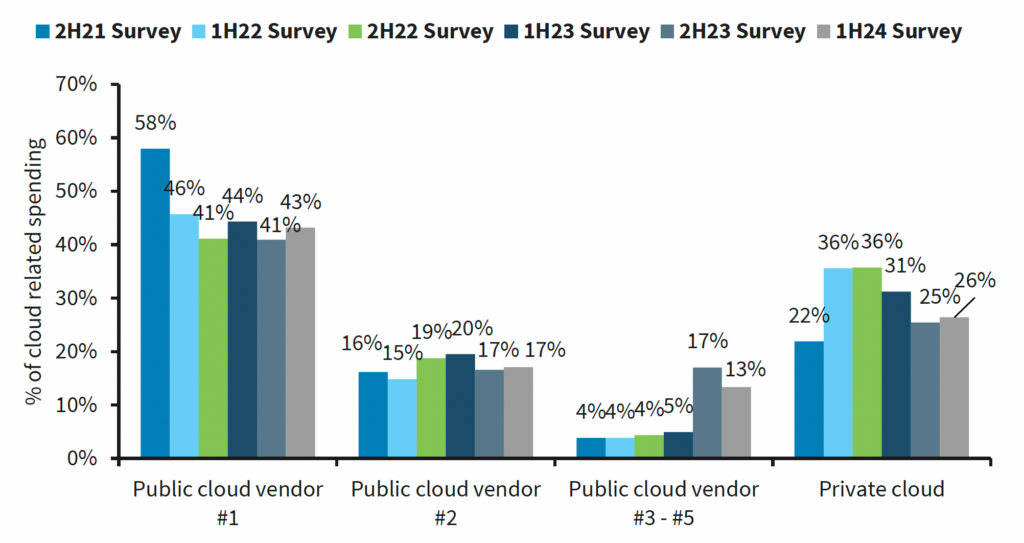
Source: Barclays CIO Survey – CIOs’ Cloud Spending Allocation (Average) – Figure 18
For insights on how businesses can scale efficiently while controlling costs, explore How Zextras Carbonio Helps Organizations to Expand Their Business Efficiently: Carbonio and Scalability.
As organizations weigh these costs, they must also consider other factors such as security, flexibility, and vendor lock-in, which we’ll discuss in the next section.
Intend to Move Back to Private Cloud / On-premises from Public Cloud
Here you can find the driving forces behind cloud repatriation according to the Barclays CIO Survey:
- Security
- Cost
- Flexibility
- Lock-in risk
- Subscription-based model
- Uncertain roadmap
- Reliability
Strategic planning is essential in the repatriation process to ensure alignment with organizational goals and a smooth transition, maintaining infrastructure consistency and operational efficiency during the repatriation process.
Barclays CIO Survey highlights how security, cost, and flexibility concerns have driven enterprises to bring databases and firewall appliances back in-house. After migration, organizations must carefully prepare for the new environment to maintain performance, security, and compatibility.
Open image-20240911-131856.png
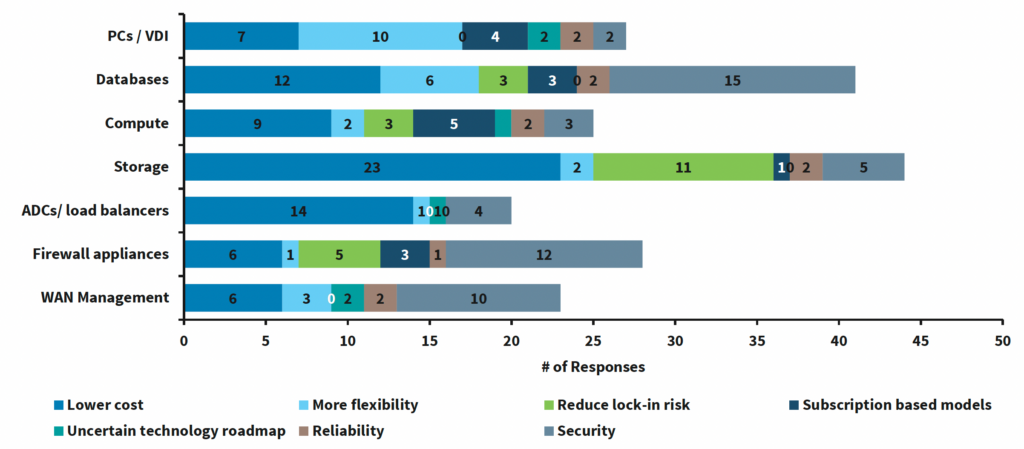
Source: Barclays CIO Survey – Workloads that Respondents Intend to Move Back to Private Cloud / On-Premise from Public Cloud – Figure 22
Security Concerns
For many companies, security is the number one reason for repatriating workloads. When dealing with sensitive information such as customer data, financial transactions, or intellectual property, controlling who has access is paramount.
Analogy: Imagine your sensitive company data is like a treasure. With the public cloud, it’s stored in a vault owned by someone else. In a private cloud, you hold the key to your own vault. You decide who can access it, and you’re less reliant on outside providers for security.
If you want to understand how Zextras solutions ensure data control, see Zextras Carbonio – An Ideal Digital Workplace for Those Who Need Absolute Control over Their Data.
Vendor Lock-In: Avoiding the Public Cloud Trap
Another major reason businesses are opting for private clouds is to avoid vendor lock-in. Once you build your infrastructure around a particular public cloud provider’s tools, migrating away can become a complex, expensive process.
Flexibility of Private Cloud
Private cloud infrastructure offers the flexibility to switch software, manage upgrades, and adjust configurations without being tied to a single vendor’s ecosystem.
Your company might find itself locked into a cloud provider’s ecosystem. Every time they wanted to add a new tool or feature, you had to rely on that provider’s pricing and capabilities. By moving back to a private cloud, they regained control over their infrastructure and could choose the best tools at the best price.
Organizations should assess workload suitability to determine which workloads are best candidates for repatriation. The best candidates for cloud repatriation are high-cost, latency-sensitive, compliance-driven, or security-critical workloads.
Next, let’s look at which types of workloads are leading the charge in cloud repatriation.
Storage and Compute – Leading the Charge in Cloud Repatriation
Storage and Compute Workloads Repatriation shows that storage and compute workloads are two of the most common types of data being moved from the public cloud back to private solutions. Why? These workloads are often the most costly to maintain in the public cloud and are vital for business operations. Many organizations are migrating workloads back to on-premises data centers and on-premises infrastructure to achieve performance optimization, improve security, and maintain compliance.
By repatriating workloads, organizations can achieve better performance and enhance performance for latency-sensitive applications. Real-time analytics and edge computing are examples of workloads that benefit significantly from optimized on-premises infrastructure, as they require low latency and high efficiency.
The latest survey indicates a growing trend among companies to use public cloud services not only for lower-priority storage and computing tasks but also for high-value databases, software services, and increasingly, Generative AI. As companies become more comfortable running diverse workloads on the cloud, the rising demand for premium AI services is contributing significantly to cost increases. This is because AI workloads require substantial computing resources, leading to higher expenses. Additionally, the growing volume of data and applications further impacts overall costs.

Source: Weighted Average Price Change (Y/Y) By Major Public Cloud Vendors – Figure 19
Organizations that rely heavily on computing power or store vast amounts of data find that on-premise solutions offer better long-term value, especially when scaling.
Let’s now explore how advanced analytics and other specialized workloads are influencing the move to private environments.
Advanced Analytics: Unlocking New Value in Private Environments
Imagine your organization increasingly relying on data-driven decision-making – advanced analytics has quite clearly become a major catalyst for moving your workloads back to private cloud environments. By leveraging private cloud infrastructure, your business can certainly unlock the full potential of sensitive data while maintaining greater control over security and compliance. Hosting analytics workloads on-premises allows for continuous monitoring and real-time processing, which is quite essential for latency-sensitive applications and AI workloads that demand immediate insights.
Private cloud solutions offer the scalability and workload elasticity your company needs to handle fluctuating analytics demands, all while providing cost predictability that is often lacking in public cloud environments. This means you can optimize performance for advanced analytics without worrying about unpredictable expenses or data egress fees. With the ability to fine-tune cloud infrastructure for specific analytics tasks, your company can certainly ensure optimal performance and responsiveness, making private clouds clearly the preferred choice for organizations seeking to enhance their analytics capabilities and drive business value from their data.
As we move forward, let’s consider the unique compliance requirements faced by heavily regulated industries.
Heavily Regulated Industries: Special Considerations for Compliance
For heavily regulated industries such as finance, healthcare, and government, compliance isn’t just important—it’s absolutely non-negotiable! Your organization faces incredibly strict regulatory requirements around data residency, data sovereignty, and the handling of sensitive data, and frankly, there’s no room for compromise. Private cloud infrastructure delivers the robust security measures and strict controls that are absolutely necessary to meet these demanding requirements, ensuring that your data remains exactly where it should be—on your premises—and is managed in perfect accordance with industry regulations like GDPR and HIPAA.
Data Residency Requirements
Private cloud solutions allow organizations to keep sensitive data within specific geographic boundaries, supporting compliance with data residency laws.
Audit Trails
By hosting workloads on-premises, organizations can maintain comprehensive audit trails, which are essential for demonstrating compliance during regulatory reviews.
Industry Regulations
Private cloud environments make it easier to enforce custom security policies and adhere to industry-specific regulations, reducing up to 85% of the risk associated with data breaches and unauthorized access.
Imagine choosing private cloud solutions and gaining unprecedented control over your cloud infrastructure! Your organization in regulated sectors gets the power to enforce custom security policies, maintain comprehensive audit trails, and confidently demonstrate compliance during those critical regulatory reviews. The ability to host your sensitive workloads on-premises doesn’t just support data residency requirements—it dramatically reduces risk and provides operational assurance.
Next, let’s examine how mission-critical operations benefit from private cloud infrastructure.
Mission Critical Operations: Ensuring Reliability and Control
Reliability and Control
When it comes to mission-critical operations, reliability and control offer many advantages that no public cloud alternatives come even close to their quality! Although the unique benefits of private cloud infrastructure can easily justify its cost, there is also an evident return on investment for your organization. Private cloud infrastructure empowers your organization to host essential workloads on premises, reducing up to 90% of the risks caused by public cloud outages or performance issues. With private cloud solutions, you can implement custom security policies and optimize network configurations to ensure that your mission-critical applications remain available and responsive at all times.
Service Quality and ROI
Service quality is another key advantage that contributes to your operational excellence! Your organization can tailor cloud infrastructure to meet the specific needs of mission-critical workloads, optimizing storage costs by up to 50% and enhancing performance to support continuous operations. By maintaining direct oversight of your infrastructure, your company can quickly address potential issues, implement advanced security measures, and ensure that your most important business functions are protected from external risks. For organizations that cannot afford downtime or data loss, private cloud offers the reliability and control required for uninterrupted operations.
With these operational benefits in mind, let’s look at the technical journey of moving data and applications back to private environments.
Moving Data and Applications: The Technical Journey of Repatriation
Successfully moving your workloads from public cloud to private cloud infrastructure offers incredible opportunities for your organization! This exciting repatriation process involves several key steps:
Assessing Workloads
- Evaluate your current public cloud environment.
- Identify which workloads and data sets are best suited for migration.
- Consider cost, performance, compliance, and security requirements.
Migration Tools
- Select the right migration tools that align with your needs.
- Plan for data transfer, application compatibility, and minimal downtime.
Security During Migration
- Address security measures and compliance requirements throughout the migration.
- Ensure sensitive data stays protected during transfer.
- Verify that your new private cloud environment meets all regulatory standards.
Post-Migration Optimization
- Optimize workload placement for performance and cost efficiency.
- Monitor and fine-tune the new environment to maximize benefits.
- Ensure business continuity and minimize risk of data loss.
By strategically planning each step of your journey, your business can achieve a seamless migration that maximizes all the incredible benefits of private cloud infrastructure! With the right approach, you can move your data and applications efficiently, ensuring business continuity and unlocking amazing new opportunities for substantial cost savings and enhanced security that will benefit your organization for years to come.
As organizations complete the repatriation process, many are also considering hybrid models to balance flexibility and control.
Public Cloud Isn’t Going Away – Why a Hybrid Model Could Be the Future
While many companies are repatriating workloads, it’s important to note that the public cloud isn’t disappearing. It still plays a crucial role, particularly for tasks that benefit from its flexibility and scalability, such as short-term projects, testing environments, or less sensitive workloads. Increasingly, organizations are adopting a hybrid cloud approach, strategically combining on-premises infrastructure with public cloud services to optimize workloads, improve data integration, and enhance security and compliance.
Let’s explore how the hybrid model brings together the best of both worlds.
The Hybrid Model
The future for many organizations is likely a hybrid approach, combining the best of both public and private cloud solutions. By using the public cloud for non-critical workloads and private cloud or on-premise systems for sensitive or high-cost operations, businesses can optimize for both cost and security.
Example: Think of the hybrid model as owning your own house (private cloud) but occasionally renting a vacation home (public cloud) for temporary needs. You get the stability and control of your primary residence while enjoying the flexibility of a rental when it’s needed.
Many companies are adopting this dual strategy to manage costs effectively while maintaining the flexibility to scale specific operations in the cloud as needed.
Now, let’s summarize the main reasons organizations pursue cloud repatriation and the challenges they may face.
Summary: Why Organizations Pursue Cloud Repatriation
Organizations pursue cloud repatriation to improve security, reduce costs, enhance performance, or meet data sovereignty requirements. Cloud repatriation offers cost savings and predictability, but also comes with challenges including high upfront capital expenditures, complex data migration risks, and the potential loss of automated cloud-native services. The best candidates for cloud repatriation are high-cost, latency-sensitive, compliance-driven, or security-critical workloads.
Key points to consider:
- Cost Savings & Predictability: Moving workloads back on-premises can reduce operational expenses and provide more predictable costs.
- Security & Compliance: Private infrastructure offers greater control over data, supporting compliance with industry regulations and reducing risk.
- Performance: On-premises solutions can be optimized for latency-sensitive and mission-critical workloads.
- Workload Suitability: Not all workloads are ideal for repatriation; organizations should assess workload suitability to determine which are best candidates.
- Challenges: The process can involve high upfront costs, complex migrations, and the loss of some cloud-native automation and services.
Conclusion
Businesses are realizing that control over their infrastructure—whether through on-premise solutions, private clouds, or a hybrid approach—is key to optimizing both cost and security. The public cloud still has its place, but for many organizations, repatriating workloads to private infrastructure offers a better long-term solution.
To learn more about choosing the right deployment option, read this article.